

SONA 2026: Solar PV industry stands ready to be the engine of change in SA
South Africa’s solar PV industry stands ready to be become the backbone of a competitive, low-carbon economy. This was the response from SAPVIA, in response to the State of the Nation Address delivered on Thursday night.
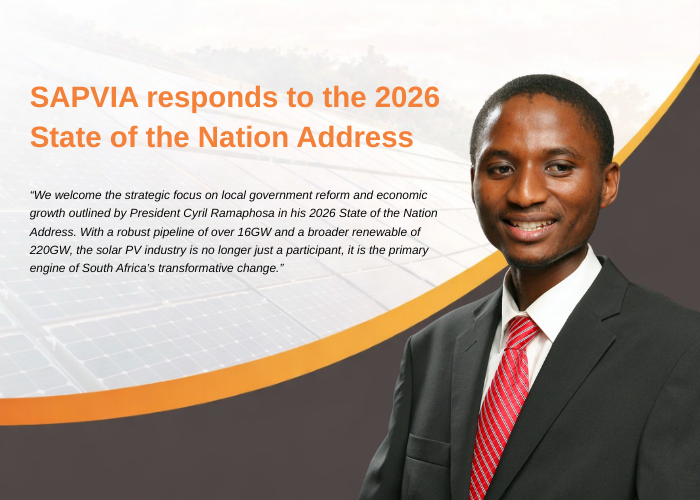
“We welcome the strategic focus on local government reform and economic growth outlined by President Cyril Ramaphosa in his 2026 State of the Nation Address. With a robust pipeline of over 16GW and a broader renewable of 220GW, the solar PV industry is no longer just a participant it is the primary engine of South Africa’s transformative change, said Mr Sim Khuluse, Technical and Policy Manager of SAPVIA.
“President Ramaphosa’s call for 2026 to be a year of transformative change resonates deeply with the solar PV industry. Momentum is building, but a clean energy future remains stalled behind the grid. Grid access is the ultimate bottleneck, without it, renewables remain constraint. Unlocking our infrastructure isn’t just a technical fix, it is the only way to ensure the energy transition uplifts every South African,” said Khuluse.
National commitment can be undermined by local government inconsistency. While the President aims to fix local government, SAPVIA remains concerned that inconsistent municipal implementation of wheeling frameworks and small-scale embedded generation (SSEG) rules continues to frustrate private investment. For the solar transition to succeed, the relationship between distributors and citizens must be based on clearly articulated guidelines and efficient systems rather than punitive measures.
“Furthermore, we welcome the President’s commitment to establishing a fully independent transmission entity with ownership and control of assets, free from the structural constraints of Eskom Holdings. This marks a transformative milestone for the country’s energy landscape,” he added.
In 2026, SAPVIA will continue to advocate for a fully liberated energy ecosystem and modernised distribution networks that unlock the power of decentralized solar to transform rural economies, turning sunlight into the backbone of South African irrigation, refrigeration, and industrial growth.
“We are committed to ensuring that the R72 billion in private investment expected by 2030 translates into local value, creating jobs, manufacturing capacity, and energy security for all,” said Khuluse.
/ends


